
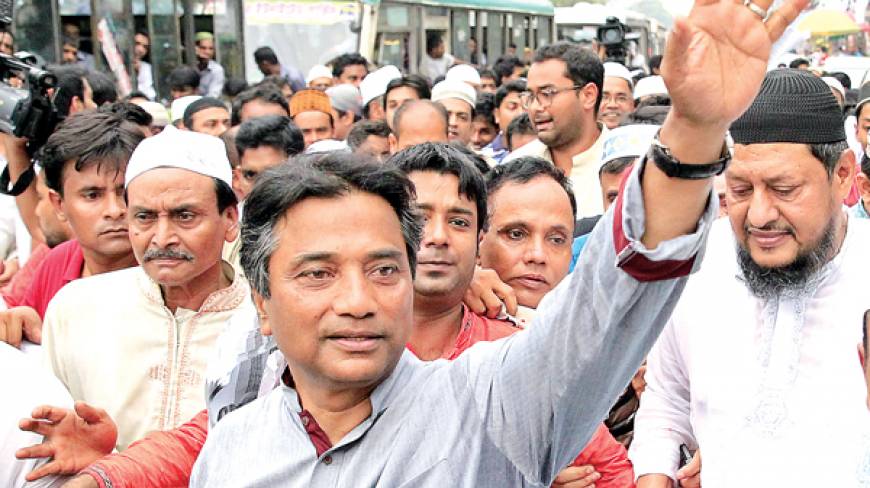
Annisul Huq seems, at first, a little taciturn as we sit down to talk on Saturday. He smiles and talks about the city poll elections in Dhaka. “I would have been happier if the BNP had stayed in the race – then there would be no questions.”
I later realise he is reluctant to comment on the work ahead before he has the chance to meet his staff and survey the problems at hand. “If I say anything before I have a chance to really understand what the issues are, then I’d just be making pretty speeches.”
Speechifying for the sake of it is simply not Annis’ style. The mayor-elect seems genuinely committed to his campaign manifesto, a set of objectives distilled from the results of a survey his camp conducted.
The central focus of the six-point manifesto is the cleaning and greening of the capital. “But not just the capital … the whole country.”
“We want a clean Dhaka, in every sense of the word. This is my dream job,” the mayor-elect says.
The ruling party’s favourite for the Dhaka north mayorship, Annis was asked to stand for the post by Prime Minister Sheikh Hasina.
When asked why she had chosen him, he is charmingly matter-of-fact: “Only she can answer that, I think.
“I’m here from a sense of responsibility.”
He dismisses claims that he sat on his laurels as the premier’s pick, saying he campaigned as hard as the next man. “I wanted the people to feel I was committed. We ran a good and effective campaign.”
His wife and chief election agent, Rubana Huq agrees: “We campaigned like crazy. Our effort was genuine and intense.”
His voice hoarse from campaigning, Annis takes a puff from the inhaler his doctor has prescribed to help him recover from the strain. “I expected to win. I was confident – I worked hard. I gave my best to this effort.”
Then he becomes thoughtful again and says: “I did not expect it to get so political.”
The Huqs are not exactly new to public life.
Annis has served two terms as president of the Bangladesh Garment Manufacturers and Exporters Association, and as president of both the Federation of Bangladesh Chambers of Commerce and Industry and the Saarc Chamber of Commerce and Industry.
But the relatively genteel work of managing stakeholders in business forums is a far cry from the rough and tumble world of party politics.
Rubana explains: “Some of the other candidates come from political families: They knew what to expect. We are learning as we go. Annis is a deeply private individual; privacy is now a luxury.”
Both Annis and Rubana appear committed to the theoretically non-partisan character of Dhaka’s two mayorships.
“There is really no way to look at this as a political assignment. If he [Annis] did think of it this way, he would be wrong,” Rubana says.
“He sees it as a combination of an administrative and political job. It has to be teamwork,” she says.
Annis agrees and intends to bring the entirety of his personal network to bear on Dhaka north city’s problems. “I want to make an effort to create employment. And I will ask my friends in business to help make this possible.”
He envisions a Private-Public Partnership model and considerable citizen engagement and cooperation to get things done for the city.
“I want to mobilise mass contact efforts to encourage tree planting and greening in individual homes. Of course this will cost householders some money as well, but we all have a stake in how we take care of our city.”
He hopes to work in collaboration with the federation of chambers of commerce and citizen-led action is another thing he wants to foster.
“In addition to the mayorship, we intend to remain active with the Amra Dhaka platform,” Rubana says.
But the mayor-elect is open to admitting that he doesn’t yet have a plan for every issue raised in his campaign manifesto.
For instance, on the question of dealing with sky-rocketing rents and the need for affordable housing, Annis does not feel ready to comment.
“We are talking to experts. We are working out how to get the land for low-cost housing projects.
2021/12/dt-pg-1640501790753.jpg
“Some of our six manifesto objectives are immediately actionable. Others are mid- and long-term targets.”
Annis has all of the makings of Dhaka’s first technocratic mayor, driven to squeeze the most out of technology. “E-tendering is high on my agenda to clean up corruption. Digitising a range of services and public sector products will change things for the better.”
The Mohammadi Group which Annis founded and is managed by his wife owns a power plant, an IT services firm and garment units with a production capacity of three quarters of a million items of clothing per month.
The consummate manager, Annis’ style appears to be to identify problems, get his managers to present alternatives, host a team of experts to suggest best practices, lobby stakeholders to get involved and then get to work.
He has put together a 12-member advisory committee to tackle the issues on his six-point manifesto and regularly entertains experts on a variety of urban management issues to sound them out about options.
“Shobuj Dhaka is waiting to meet me in the next room. City corporation officials have been given three days to give me a PowerPoint presentation on the clean-up situation. I want to start the cleaning as soon as possible,” Annis says.
Aside from cleaning up the city, tackling Dhaka’s mosquito menace is high on the list of priorities. “This will require dealing with sewerage lines, drains and water bodies beyond Dhaka north. We will have to work with neighbouring areas to get things done.”
Annis, despite his sore throat, is now passionately running down his to-do list. His excitement is infectious.
I dampen the mood slightly as tea is being served, asking him what he thinks his biggest obstacle will be in working with the city corporation bureaucracy.
He thinks for a moment, looks me in the eye and replies frankly: “I do not have the answer – yet. Perhaps they do not have the right orientation …
“I think they may not have the right mindset or orientation to solve problems.”
The divisiveness and violence of party politics appear to have affected Annis and Rubana deeply, and one senses they are wary of excessive politicisation of public works issues.
The memory of the city elections evidently still rankles.
“The mayoral and councillor elections should be held separately.
“Why should we have to pay for their [council candidates’] actions?” Annis asks.
Rubana agrees: “We ran an honest campaign. Why are we being criticised?”
Therein lies the Achilles heel to sensible management and well-laid plans: The sheer unpredictability of political life.
Two days after the polls, a police escort accompanying a Dhaka north official with magistracy powers opened fire on civilians at Banani Super Market, injuring 15.
Since the buck stops with the mayor-elect, I ask him about it.
“The shooting was unfortunate. These incidents shake the confidence of neighbourhoods. I will look into it right after I start working as a mayor.”
Annis’ family appears to be aware that there is a learning curve to being a city mayor. Rubana emphasises that they are every bit as invested as stakeholders in Dhaka’s future as any other citizen. “We are his kitchen cabinet. Annis has to answer to us every morning.”
At one point in the interview, Annis gives me a hug. It is genuinely warm. For a second, I recall childhood memories of Annis on the other side of the interview, as a BTV talk-show host asking the questions instead of answering them.
It helps give context to the man who has just been elected to take on the other most thankless job in the country.
Annisul Huq is a phenomenally successful businessman who has just won an election to run half the capital because the prime minister called him up and asked him to run. All that is true.
But his passion for the job appears to be a personal thing.
I ask Annis about his timeline for delivery on the promises he has made. He is thoughtful.
“Talk to me 15 days after I am sworn into office.”
